Sign in






How NIC Interrupt Moderation Reduces CPU Load but Introduces Latency and Jitter
< BackHow NIC Interrupt Moderation Reduces CPU Load but Introduces Latency and Jitter
Interrupt moderation is a CPU-saving technique widely used in modern network interface cards (NICs). Instead of generating an interrupt for every incoming packet—a method known as per-packet interrupt processing that can overload the CPU at high network speeds—the NIC waits until a certain number of packets have arrived or a timeout has elapsed before generating a combined interrupt. This significantly reduces the number of interrupts and lowers CPU utilization, but it also introduces two side effects: additional latency and latency jitter.
In terms of latency, the waiting period introduced by interrupt moderation artificially increases packet processing time. For example, if a NIC is configured with a timeout of 100 microseconds, even a single incoming packet may have to wait 100 microseconds before an interrupt is triggered and the CPU begins processing it. This waiting time directly adds to network round-trip latency. As for jitter, when traffic is unstable, packet arrival intervals vary unpredictably, causing interrupts to be triggered at inconsistent times and resulting in fluctuating processing delays. For applications such as real-time audio and video and industrial control, this jitter can be more harmful than a fixed delay.
Different NICs use different interrupt moderation algorithms. Simple count-based moderation, such as generating an interrupt every eight packets, may still cause timeout delays under low traffic when the packet threshold is not reached. More advanced algorithms dynamically adjust timeout thresholds based on historical traffic patterns and may even determine whether to trigger an immediate interrupt according to packet quality-of-service (QoS) priorities. In addition, the Linux ethtool utility allows users to adjust interrupt moderation parameters, including rx-frames (the receive packet threshold) and rx-usecs (the time threshold). Lower values can reduce latency but increase CPU load, while higher values generally have the opposite effect.
In practical operations, the optimal configuration depends on the workload and should be determined through testing. Throughput-sensitive workloads, such as databases and web servers, may benefit from higher thresholds. Latency-sensitive applications, such as high-frequency trading and voice gateways, should use lower thresholds or even disable interrupt moderation. Some NICs also support interrupt mechanisms based on absolute timestamps, allowing packets with specific time-sensitive markings to bypass moderation and trigger interrupts immediately.
Guangruntong (GRT) NIC drivers support interrupt moderation adjustments through the standard ethtool interface, enabling users to configure parameters according to their workloads. GRT technical documentation provides recommended settings for different scenarios, including file servers, real-time communications, and virtualization hosts, helping users balance CPU load and network latency. Understanding how interrupt moderation works is an essential first step toward fine-grained performance optimization.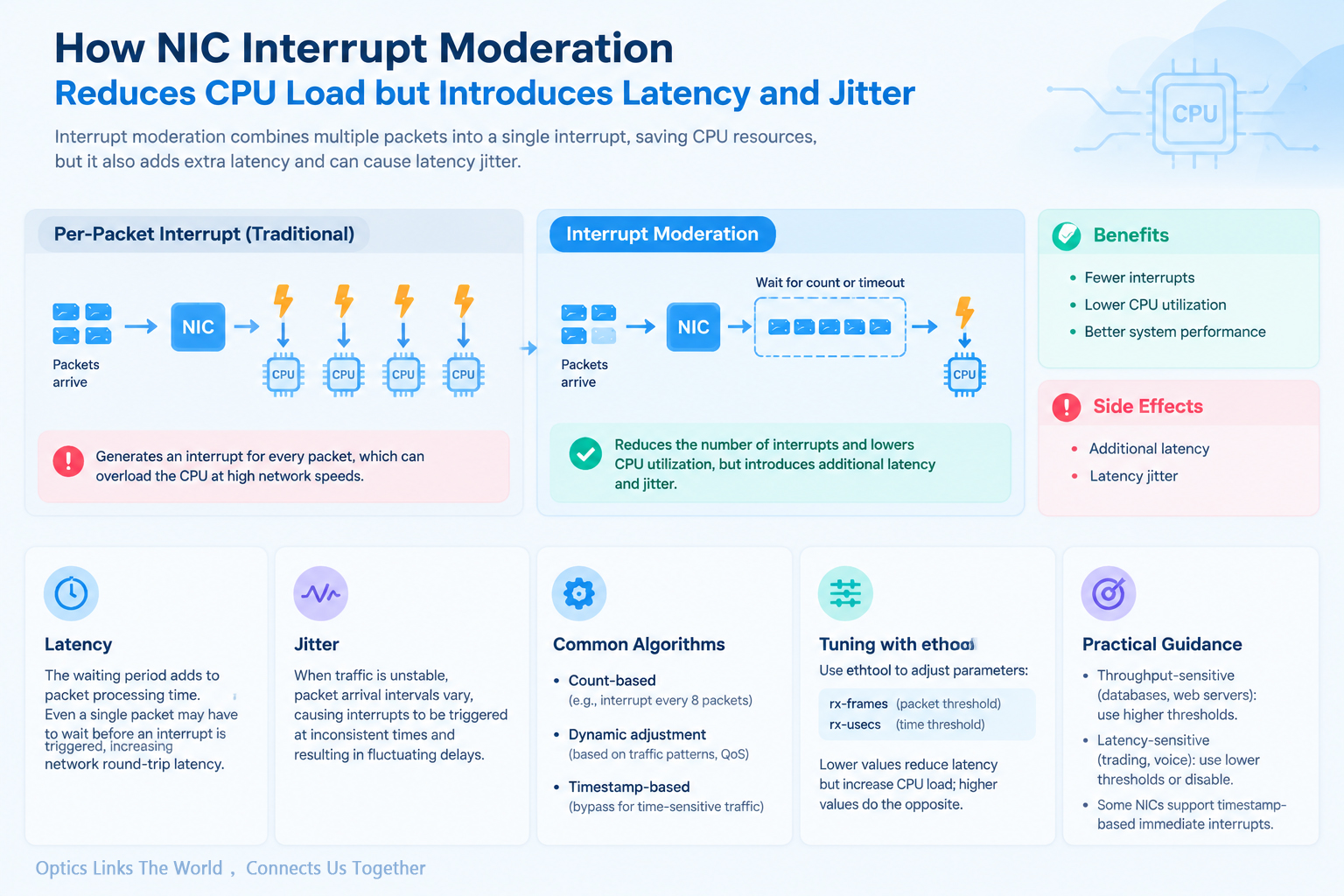
- Prev: The High-Performance Network Revolution in the AI Era: RDMA
- Next: None
Latest information
- How NIC Interrupt Moderation Reduces CPU Load but Introduces Latency and Jitter
- The High-Performance Network Revolution in the AI Era: RDMA
- NAS Storage Network Upgrade Guide
- Why Does Upgrading Your NAS to 2.5GbE Not Improve Network Speed?
- What Is an OCP 3.0 Network Card?
- The King of Cost-Effective 25G NIC: In-Depth Analysis of Guangruntong (GRT) GH2502EM-V4.1
- The Hidden Relationship Between NIC Heat Dissipation and Data Center Cabinet Layout
- Why are serpentine traces designed on the NIC PCB board